How Energy-Efficient Kitchen Appliances Make Smart Cooking Better in Nepal
November 19, 2025Looking for energy-efficient kitchen appliances in Nepal? Discover how modern gas hobs with up to 13% gas savings and 12% faster cooking, together with high-suction Arvon Range Hoods featuring strong static pressure, Nano Technology, patented blower systems, automatic self-cleaning, and efficient AC or BLDC motors, can make modern Nepali kitchens smarter, cleaner, safer, and more economical.
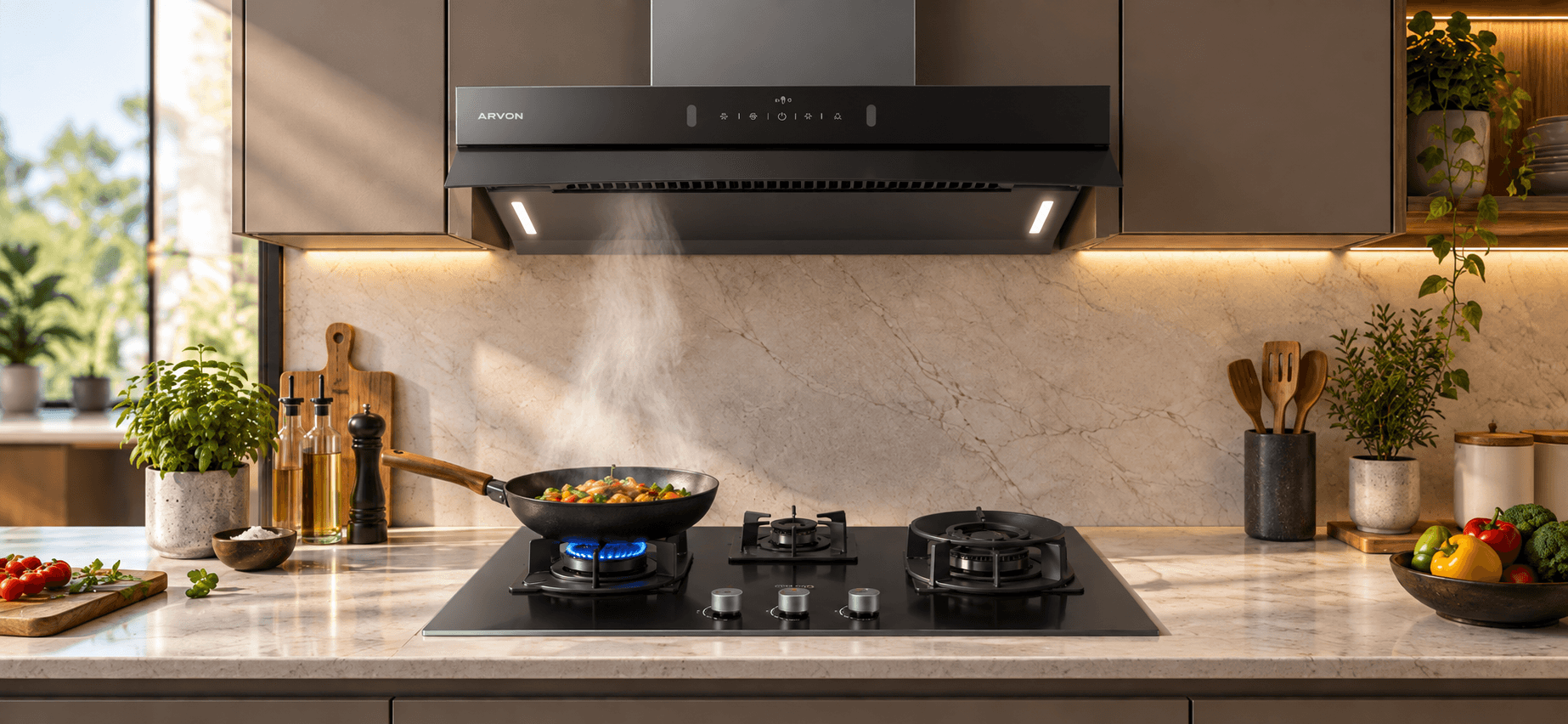
Energy efficiency is becoming increasingly important when choosing kitchen appliances in Nepal. With gas and electricity forming part of everyday household expenses, homeowners increasingly want appliances that provide strong performance without wasting energy.
For Nepali kitchens, efficiency is particularly important because appliances such as the gas hob and kitchen chimney or range hood may be used several times every day. Choosing better-engineered appliances can help improve cooking speed, gas usage, ventilation, maintenance, and long-term operating value.
When searching for an energy-efficient gas hob in Nepal, burner technology should be one of the first specifications to examine. Powerful burners alone do not guarantee efficiency. What matters is how effectively the burner transfers heat to the cookware.
Selected Arvon gas hobs incorporate Gas-Saving Technology designed to provide up to 13% gas savings while delivering up to 12% faster cooking performance. With heating efficiency of up to 63%, these burner systems are engineered to provide effective heat transfer for everyday cooking.
This is especially useful for Nepali cooking, where the hob may be used throughout the day for dal, rice, tarkari, curry, tea, frying, boiling, simmering, pressure cooking, and high-heat preparation.
Selected models feature powerful brass burners, including triple-ring Dual Flame burners that provide strong heat when required while allowing accurate flame adjustment for lower-temperature cooking.
Patented Instant Ignition makes starting the burner fast and convenient, while an FFD or Flame Failure Device provides an additional level of safety by stopping the gas supply if the flame accidentally goes out.
Heavy cast iron pan supports also improve cookware stability, while smooth glass or matt surfaces make cleaning easier.
For buyers comparing the best gas hob in Nepal, specifications such as burner output, heating efficiency, gas-saving technology, ignition reliability, safety devices, burner material, glass quality, and warranty should therefore be considered together rather than looking only at price.
The same applies when choosing a range hood or kitchen chimney in Nepal. Many buyers focus only on suction rate, but true extraction performance depends on several specifications working together.
Arvon Range Hoods offer Standard IEC airflow ranging from around 1440 m³/h to 1560 m³/h, depending on the model. This provides strong extraction for smoke, fumes, steam, cooking odors, and airborne grease generated during everyday cooking.
However, airflow is only one part of the story.
Static pressure determines how effectively a range hood can push air through ductwork. Selected Arvon models provide approximately 500 Pa maximum static pressure, while the premium Aerosense Pro T90BLDC can provide up to 1200 Pa maximum static pressure.
This can be particularly important in Nepali homes where chimney ducting may contain long runs, bends, or resistance between the kitchen and the outside exhaust point.
Motor technology also influences performance and efficiency. Arvon uses fully sealed AC motors across selected models, while premium models incorporate fully sealed BLDC motor technology.
A BLDC system can provide strong static pressure and precise motor control, making it suitable for high-performance extraction. Reliable sealed AC motors, meanwhile, provide robust everyday performance across other models.
Another important specification is grease separation.
Selected Arvon Range Hoods use Nano Technology with a patented blower system designed to separate grease and oil from the airflow. Depending on the model, oil and grease filtration rates can reach approximately 90% to 92%.
This helps reduce the amount of grease that accumulates around important internal components and supports cleaner airflow and consistent long-term extraction.
Some Arvon Range Hoods also include an Automatic Self-Cleaning System. On supported models, the cleaning function activates after 60 hours of cumulative range hood operation, helping reduce internal grease buildup.
This combination of Nano grease separation, patented blower technology and automatic self-cleaning can reduce maintenance effort while helping the hood maintain stable performance.
Arvon Range Hoods also provide 2 standard extraction speeds plus 1 Turbo mode on selected models. This allows users to choose a lower extraction level for light cooking and increase to Turbo when frying, grilling, or producing heavier smoke.
Using the appropriate fan speed instead of maximum power at all times is another simple way to operate a range hood more efficiently.
Convenience technologies including hand-gesture control and touch control make extraction easier to adjust during cooking, while sealed motor systems and durable internal components are designed for dependable long-term use.
These features are particularly relevant for modern kitchens in Kathmandu, Lalitpur, Bhaktapur, Pokhara, Chitwan, Butwal, and other developing urban areas in Nepal, where built-in gas hobs and range hoods are increasingly becoming part of contemporary modular kitchen design.
Modern ovens complete the energy-efficient kitchen. Good insulation helps retain heat inside the oven, while convection fans circulate hot air for more uniform cooking. Digital timers and temperature controls help prevent unnecessary heating and allow users to manage baking, roasting, and grilling more accurately.
When comparing kitchen appliance prices in Nepal, energy efficiency should therefore be evaluated as part of long-term value. A cheaper appliance that wastes gas, provides poor extraction, requires frequent cleaning, or performs inefficiently may eventually cost more to operate and maintain.
A better approach is to compare measurable specifications: gas-saving percentage, heating efficiency, IEC airflow, maximum static pressure, oil and grease separation rate, motor technology, self-cleaning functionality, safety systems, warranty, and after-sales support.
A smart modern kitchen in Nepal should deliver more than attractive design. It should use gas and electricity intelligently, remove smoke and grease efficiently, simplify maintenance, and provide reliable everyday performance.
By combining up to 13% gas savings, up to 12% faster cooking, 63% heating efficiency, high IEC airflow, up to 1200 Pa static pressure, 90–92% grease separation, Nano Technology, patented blower engineering, automatic self-cleaning, and efficient AC or BLDC motor systems, modern kitchen appliances can deliver a genuinely smarter approach to everyday cooking.